
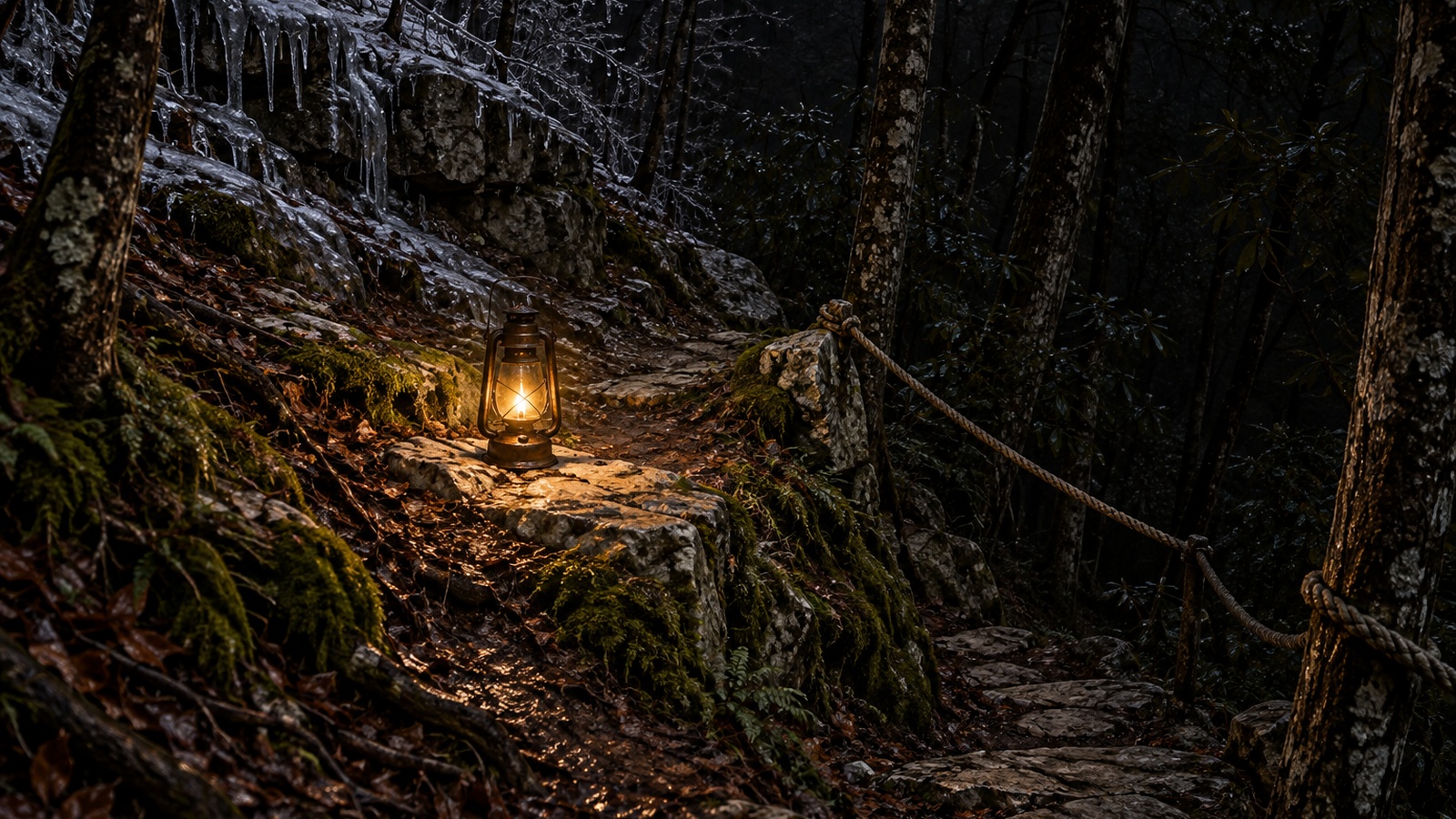
The almanac was open to the first of February, the way it had been since supper, and I had read the page three times without taking in a word of it. Ice on the road. Ice on the porch rail, thick as a thumb, and more coming down in that fine hiss that means it has no intention of quitting. The kitchen window had gone the color of a dirty nickel. I could hear the sourwood along the fence line ticking under the weight, and every so often a branch somewhere on the ridge let go with a crack like a rifle.
Luther had the stove going good. He had been feeding it all afternoon without saying why, and I had not asked him why, and that was the two of us, right there.
I got the sack down from the pantry shelf. It is an old flour sack, and the salt in it is coarse, the kind you put out for cattle, and I fill it the last week of January every year whether the old one is empty or not. There are twelve of these in a year. Eight of them you can put off a day or two for ice or a funeral or a bad knee, and Mama did, and I have. The first of February is not one of the eight. I set the sack by the door. I got the paper out of the tin on top of the cupboard, folded in four the way it was when it was handed to me, soft as cloth at the creases, and I put it inside my coat where it would stay dry against me. I filled the lantern. I trimmed the wick with the kitchen scissors and wiped the chimney with my apron, because a smoked chimney will lie to you about how much light you have.
Then the boots. Not the ones I do the chickens in. The good ones, with the hobnails, that Mama wore before me and that I had resoled twice. I laced them by the stove where my fingers would work.
Luther watched me do all of it from his chair. He is not a talker. When I had the second boot laced he got up and went out to the woodpile and came back with an armload, ice on his shoulders, and stacked it by the stove, and then he went out and got another one.
“I’ll keep it up,” he said.
“All right.”
That was all. He sat back down. I put my coat on over the paper and my hat on over my ears and took the lantern in one hand and the sack in the other and went out the back, and I did not look at him going, because you don’t. It makes it into something, and it isn’t something. It is the first of February.
The yard was glass. I went down it sideways, the way you go down a creek bank, and let the fence carry me to the corner and the gate, and after the gate there is just the pasture and then the dark where the pasture stops. The ice hissed on my hat. The lantern made a little room around me and the room went with me and nothing else was there. I have never in my life liked that part.
At the bottom of the pasture the ground tips and the trees come up close, and there are the posts.
Two locust posts and a crosspiece, and sourwood grown up so thick on both sides that there is one way through and that is under. The bell hangs in the crosspiece. It is not a big bell. It is not pretty. It is the color of an old skillet and it has a rope, and the rope goes down beside the path into the dark and you cannot see where it ends because it ends at the water, and you cannot see the water from here. Nobody can see the water from here.
I put my hand on the rope. Not to ring it. You just put your hand on it, the way you put your hand on the door frame of a house you are coming into, so it knows you. Mama did that. Her mother did it. I do not know if it means anything and I have never asked anybody, because there is nobody to ask, and because I already know the answer, which is that nobody knows.
The ice was on the rope too. It cracked under my glove and came off in a sleeve. I let go of it and went under the crosspiece and started down.
I count them. The switchbacks. There are seven, and every keeper I know of counted them, and I think it is less that you need to and more that your mouth wants something to do. Mama counted out loud. I count under my breath. One, at the big rock. Two, at the place where the roots come out of the bank like fingers. The path is not steep the way stairs are steep, it is steep the way a roof is, and in ice you do not walk it, you let it have you a little at a time and keep your free hand out for the rope.
The rope was there the whole way. That is what it is for. It was a hard cold thing in the dark and I could not see it but I could touch it, and once between two and three I put my whole weight on it when my boot went, and it held, and I stood there breathing with the lantern swinging and the ice coming down on me and did not think about anything at all.
Three, at the dead chestnut.
And then somewhere below three the air got thick.
I do not know how else to say it. It is like going into the springhouse in August, that heavy cool that sits on your arms, except the way it should be it is the opposite. Behind me was February. Ahead of me the air had weight and it had a smell, green and wet and a little bit rotten the way a spring is, and the ice quit. It just quit. One step it was hissing on my hat and the next step it was not, and I turned the lantern up and looked at the rocks alongside the path and there was moss on them. Green moss, not winter brown. Green like June. There was a fern coming up out of a crack that had no business being anything but a dead brown curl this time of year.
I was told about that. I was shown it. It was still the thing I had to get past every time, and I stood a minute and got past it, and went on.
Four.
Somewhere past four there was a color down ahead of me, low, where the path went. It was not the lantern. The lantern is yellow and it is mine and it goes where I point it. This was down in the bottom of the hollow and it did not go anywhere, and I did not point the lantern at it, and I did not look at it. That was the first thing Mama ever told me about this path, before she told me about the salt or the words or any of it. You don’t look at the light. I was nine and I asked her why. She said because she was telling me not to. I asked her if she had ever looked at it and she said no, and I believed her, and I have been down this path more years than I care to count and I have never wanted to look, not once. That is the truth. Some things a body just does not want, the way you don’t want to put your hand on a stove.
Five. Six. The path goes level for a stretch there and then drops the last time.
Seven. And the water.
The spring comes out of the rock in the bottom of the hollow and makes a pool the size of a wagon bed and runs off downhill into the laurel, and around the pool there is a ring of stones. Not stacked. Set. Flat ones, old, with the moss up over the edges of them so you would have to know they were there. And at four places around the outside of the stones, on the ground, is the salt.
The old was still there. Four heaps gone gray and low, the way a year leaves them, and one of them half washed into the grass where the ground had heaved with the wet. I set the lantern down on the biggest of the stones, the one that is worn in the middle like a doorstep.
The ring first. The winter had dropped what it drops into it, a fall of dead laurel leaves and a limb the size of my arm lying across two of the stones and a scum of the same on the near edge of the water. I went along the ring, what Mama called the line, on my knees and cleared it, the limb and then the leaves, and put it all back in the laurel where it came from, and then I leaned out over the doorstep stone and skimmed the water with my hand until the edge of it ran clear. That is not the salt. You do that before the salt. Nobody told me why and I never asked.
Then the sack. You start at the heap where you came in and you go around the one direction, and you do not hurry. That is the part I have to tell myself every year. There is a thing in you that wants to be done, down here, and you do not let it pour the salt. I went on my knees at the first heap and I poured it out of my fist onto the old gray until the gray was gone under the white and the heap stood up the height it ought to. Then I got up, and went to the next one, and got down. Four times. The one that had washed I built back from nothing, where it had been, and it took the longest. My knees got wet through and then they got cold and then they quit telling me anything, and I came back around to the first heap with the last of the sack and stood there looking at four white places in the dark, and the water running clean between them, and that was that done.
Then I got up, and my knees told me about that, and I took the paper out of my coat.
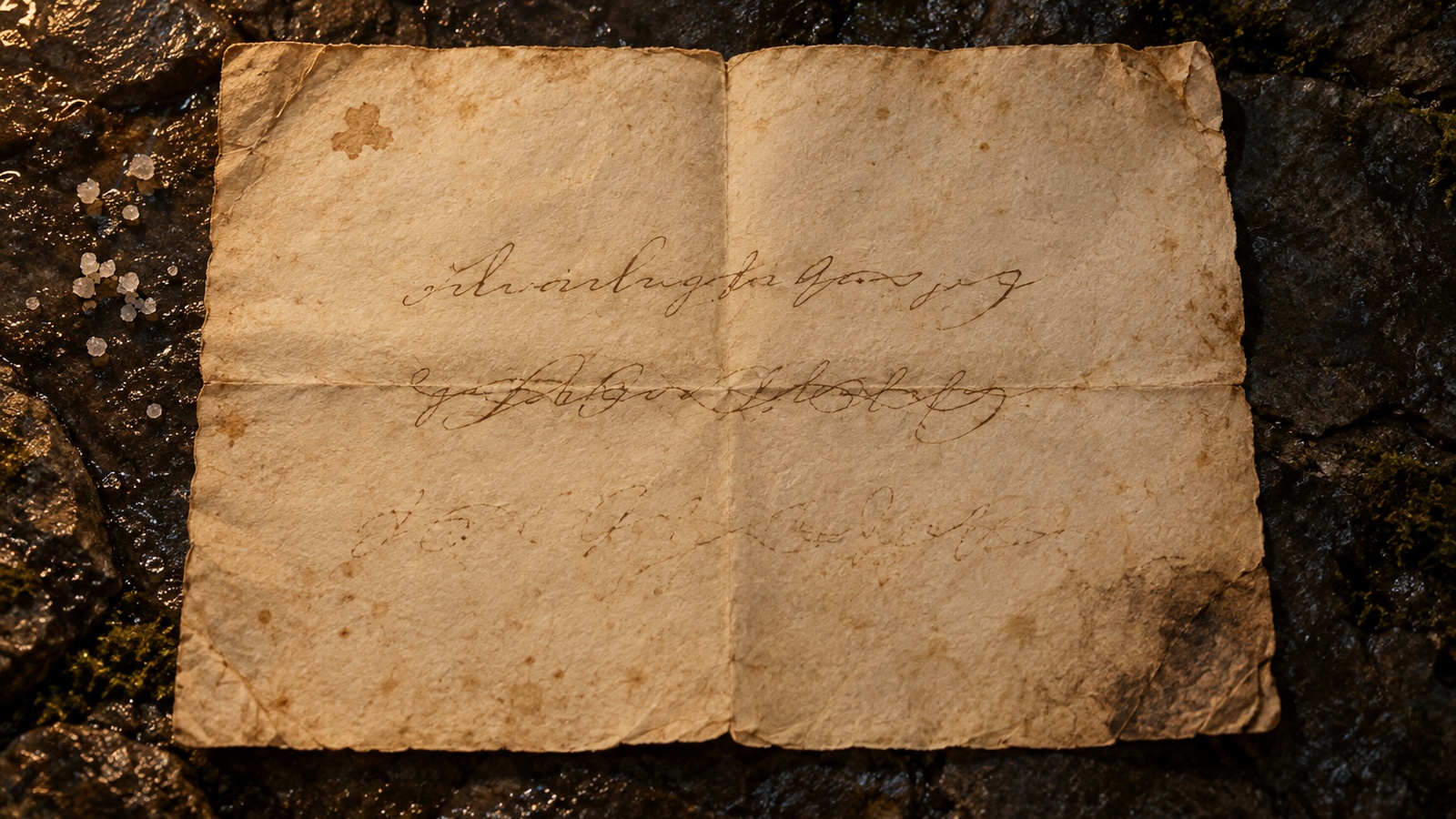
I do not know how old it is. It is not the first one. Mama told me hers was copied off her mother’s when it got too soft to read, and she copied it for me the winter before I needed it, sitting at the same kitchen table I had eaten supper at tonight, with her tongue in the corner of her mouth. I have never copied it. I am going to have to.
The writing on it is not writing. I mean it was, once. You can see it was. There are letters in it that are letters, and then there are shapes between them that were letters two or three hands ago and have gone into something else, a loop where there ought to be a tail, a mark like a hook.
I held it up to the lantern, out of habit, the way you would hold a letter.
And I said it.
Nobody has ever asked me to spell it and nobody ever will. If they did I could not. I cannot read the paper, and Mama could not, and if I had to guess I would say nobody has for a long time. That is not what it is for. You hold it and you say what your mother said, the way she sounded it. It starts with a sound like somebody clearing their throat, soft, and it ends with a sound like the wind does in the stovepipe, and what is between I could not put in letters if you paid me. It does not sound like that in my mouth. It sounds like Mama, and Mama sounded like her mother, and it is not English and I do not think it ever was, and I do not know one word of it. Not one. I have said it every month of my grown life and I could not tell you if it is a prayer or a warning or a piece of a song.
I said it twice. You say it twice.
The second time the air did what it does.
I do not have a good word for it. Mama said attends and I have never found a better one. Nothing moves. Nothing speaks. There is no shape in the dark that was not in it before. It is that you are being watched, from below, from the water, and from all around you at once, the way you are watched in a room full of people who have all gone quiet. And the watching is not angry. That is the thing I would want somebody to know, if I was ever able to tell anybody. It is not angry. It is something more like satisfied. Like a dog that has been waiting on a porch and hears the truck.
The lantern flame leaned over. Once. It leaned the wrong way, up the hollow toward the path, toward the way I had come, when there was no draft coming from anywhere. It stayed that way for the length of a breath, bent like a blade of grass, and then it stood back up.
That is all. That is all it has ever been. I have never had more than that and I have never asked for more than that and if it ever gave me more I believe I would set the lantern down and walk into the laurel and not come back, and I would understand any keeper who did.
I folded the paper and put it back inside my coat.
When I picked the lantern up off the stone I felt it in my hands.
That is the part nobody tells you, and I think it is because nobody has words for it. My hands were tired. Not the way your hands are tired after a day at the washboard. That kind of tired sleeps off. This was a tired that felt like it had been put into them, poured in, and the level had come up. The way you are tired on the last day of a long winter when you look at your own hands and think, whose are those. Mama looked older than she was. Her mother did. People in town used to say it was the hard living out here, and I let them.
I put the sack, empty, inside my coat with the paper, and I took hold of the rope, and I started up.
Coming up is counting backward, and I did not count all of it. I went hand over hand on the rope and let my boots find what they could. The rope was wet and warm down here, if you can believe that, warm the way a hand rail is warm in a house. I did not look back down at the color. It did not want looking at and I did not want to look. The moss went with me a ways, green on the rocks, and the fern, and then it did not.
And somewhere below the dead chestnut the air thinned out and the cold came in like a door had been opened, and my next step crunched.
The ice was back. Just like that. It had not been raining ice under the tree line and it was raining ice here, and the rope in my hand went from warm to cold to iron in the space of three pulls, and my breath went white in front of the lantern for the first time since I had gone under the bell. Like it had been waiting. Like February had stood at the tree line the whole time I was gone, patient.
Then the big rock.
The posts came up out of the dark and the crosspiece and the bell hanging in it with a skin of ice on it, still, as still as it had been when I went under. I put my hand on the rope where it came down out of the bell. It had not rung. It does not ring. Every year I put my hand on it going down and every year I put my hand on it coming up and every year it has not rung, and I have never once in my life thought that was a small thing.
I went under, and up the pasture, and along the fence, and the yard was still glass and I went up it on my hands as much as my feet, and the kitchen window was still lit.
The stove was up. He had kept it up. The room was hot as August and Luther was asleep in his chair with his boots off and his stocking feet toward the fire, and his mouth open, and the last armload of wood stacked by the stove where I could reach it without stepping over him.
I did not wake him. I set the lantern on the table and blew it out. I got my boots off, which took a while, and stood the wet paper on the warming shelf to dry and put the empty sack back on the pantry shelf for next year, and I stood at the stove with my hands held out to it until they were hands again and the shaking went out of them, most of it. The clock over the stove said twenty past twelve.
Then I got the ledger out of the drawer.
It is a plain book. The kind you would keep egg money in. Mama’s hand is in it, and her mother’s, and the ones before them that I never met, on page after page going back, and it is the plainest thing in the world and I have never been able to look at it long. I turned to the place. I dipped the pen. I wrote what all of them wrote, in the words they all used, because that is what you write.
1 Feb. Tended. Line clean. Salt renewed. — H.